Publications
2025#
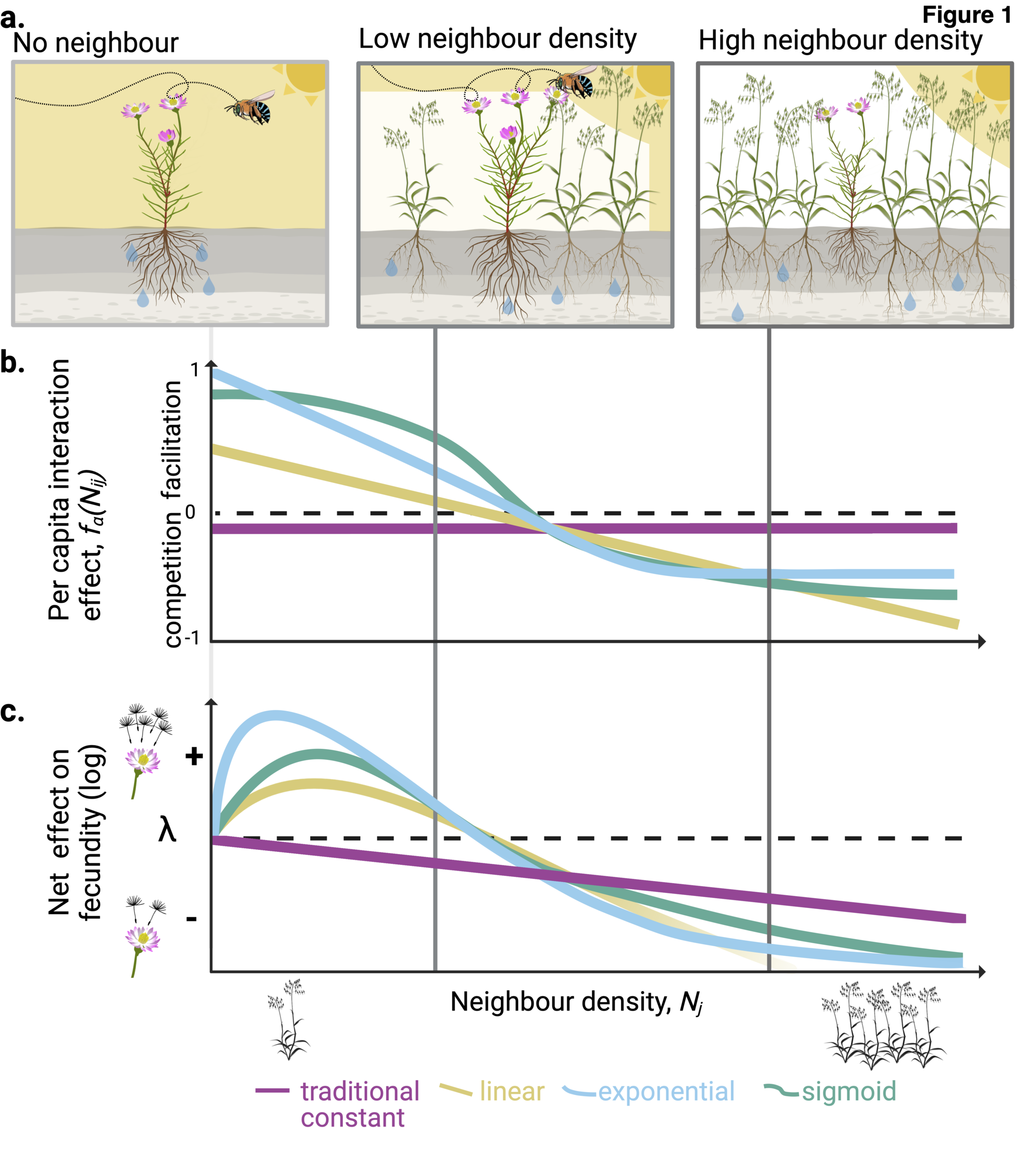
Neighbor density‐dependent facilitation promotes coexistence and internal oscillation
Buche, L., Shoemaker, L.G., Vesk, P., Hallett, L.M., Godoy, O. & Mayfield, M.
Ecological Monographs, 95(4), 2025
We developed a new way to quantifying pairwise interactions along a spectrum from facilitation to competition, acording to different non-linear functions. For the asymptotic density-dependent functions, we found that facilitation by low-density neighbouring species enhances coexistence, aligning theoretical predictions with natural observations. We tested this methodology on Lawrencella rosea, an Australian native daisy found on the land of the Dadimaya people in Western Australia.
@article{Buche2025Mono, author = {Lisa Buche and Lauren G. Shoemaker and Peter Vesk and Lauren M. Hallett and Oscar Godoy and Margaret Mayfield}, doi = {10.1002/ECM.70040}, journal = {Ecological Monographs}, issue = {4}, volume = {95}, title = {Neighbor density‐dependent facilitation promotes coexistence and internal oscillation}, year = {2025}}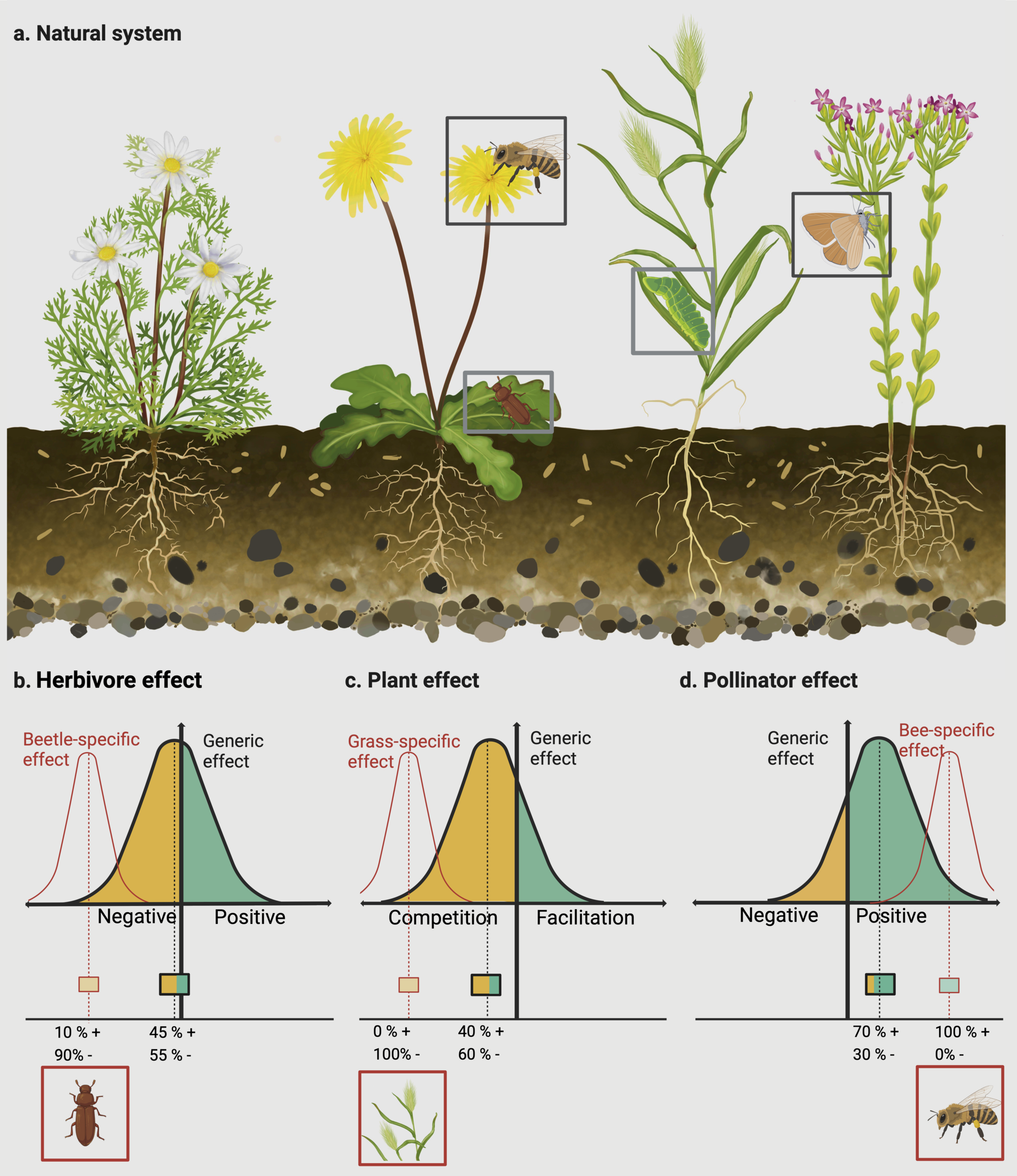
A continuum from positive to negative interactions drives plant species' performance in a diverse community
Buche, L., Shoemaker, L., Hallett, L., Vesk, P., Weiss-Lehmann, C., Bartomeus, I., Mayfield, M. & Godoy, O.
Ecology Letters, 2025
We explored the patterns of species performance, dependent on species interaction strengths and higher-order interactions with species belonging to the same and other trophic levels. We found that a continuum from positive to negative interactions, containing mostly guild-level effects and a few strong taxonomic-specific effects, was sufficient to describe plant performance.
@article{Buche2025EcoLet, author = {Lisa Buche and Lauren Shoemaker and Lauren Hallett and Peter Vesk and Christopher Weiss-Lehmann and Ignasi Bartomeus and Margaret Mayfield and Oscar Godoy}, doi = {10.1111/ele.70059}, journal = {Ecology Letters}, title = {A continuum from positive to negative interactions drives plant species' performance in a diverse community}, year = {2025}}2024#
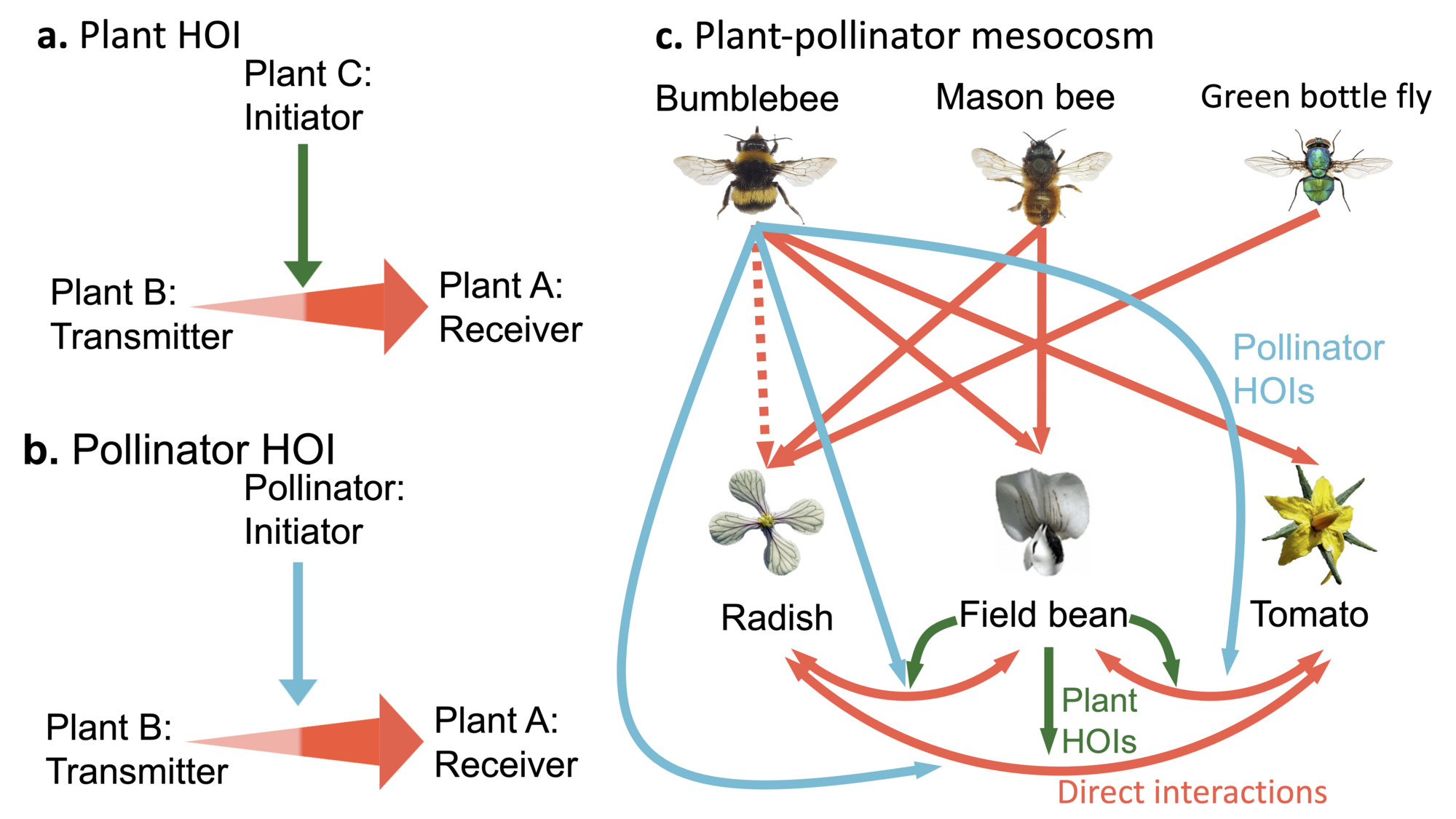
Multitrophic higher-order interactions modulate species persistence
Buche, L., Bartomeus, I. & Godoy, O.
The American Naturalist, 2024
We showed the importance of multispecies interactions in inferring species persistence. A third species can change the nature (sign and strength) of a pairwise interaction (i.e., higher-order interactions). While such interactions are traditionally ignored, we show that higher-order interactions promote the opportunities for multispecies communities to persist compared with a scenario without multispecies interactions.
@article{Buche2024, author = {Lisa Buche and Ignasi Bartomeus and Oscar Godoy}, doi = {10.1086/729222}, journal = {The American Naturalist}, title = {Multitrophic higher-order interactions modulate species persistence}, year = {2024}}2023#
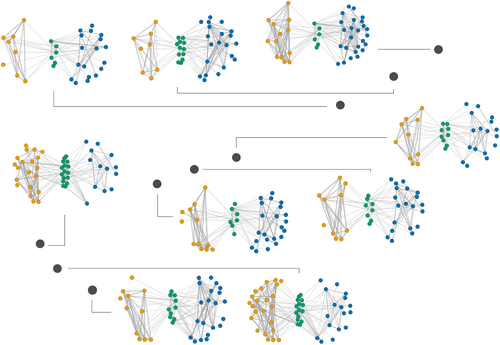
Non-random interactions within and across guilds shape the potential to coexist in multitrophic ecological communities
Garcia-Callejas, D., Godoy, O., Buche, L., Hurtado, M., Lanuza, J.B., Allen-Perkins, A. & Bartomeus, I.
Ecology Letters, 2023
Species persistence depends on the structure of their biotic interactions. The results show that biotic interactions within and across guilds are not random in nature. Considering natural complexity, such as community richness, increases the potential for species to persist and form complex communities thanks to self-regulation and niche-partitioning.
@article{GarciaCallejas2023, author = {David Garcia-Callejas and Oscar Godoy and Lisa Buche and Maria Hurtado and Jose B. Lanuza and Alfonso Allen-Perkins and Ignasi Bartomeus}, doi = {10.1111/ele.14206}, journal = {Ecology Letters}, title = {Non-random interactions within and across guilds shape the potential to coexist in multitrophic ecological communities}, year = {2023}}2022#
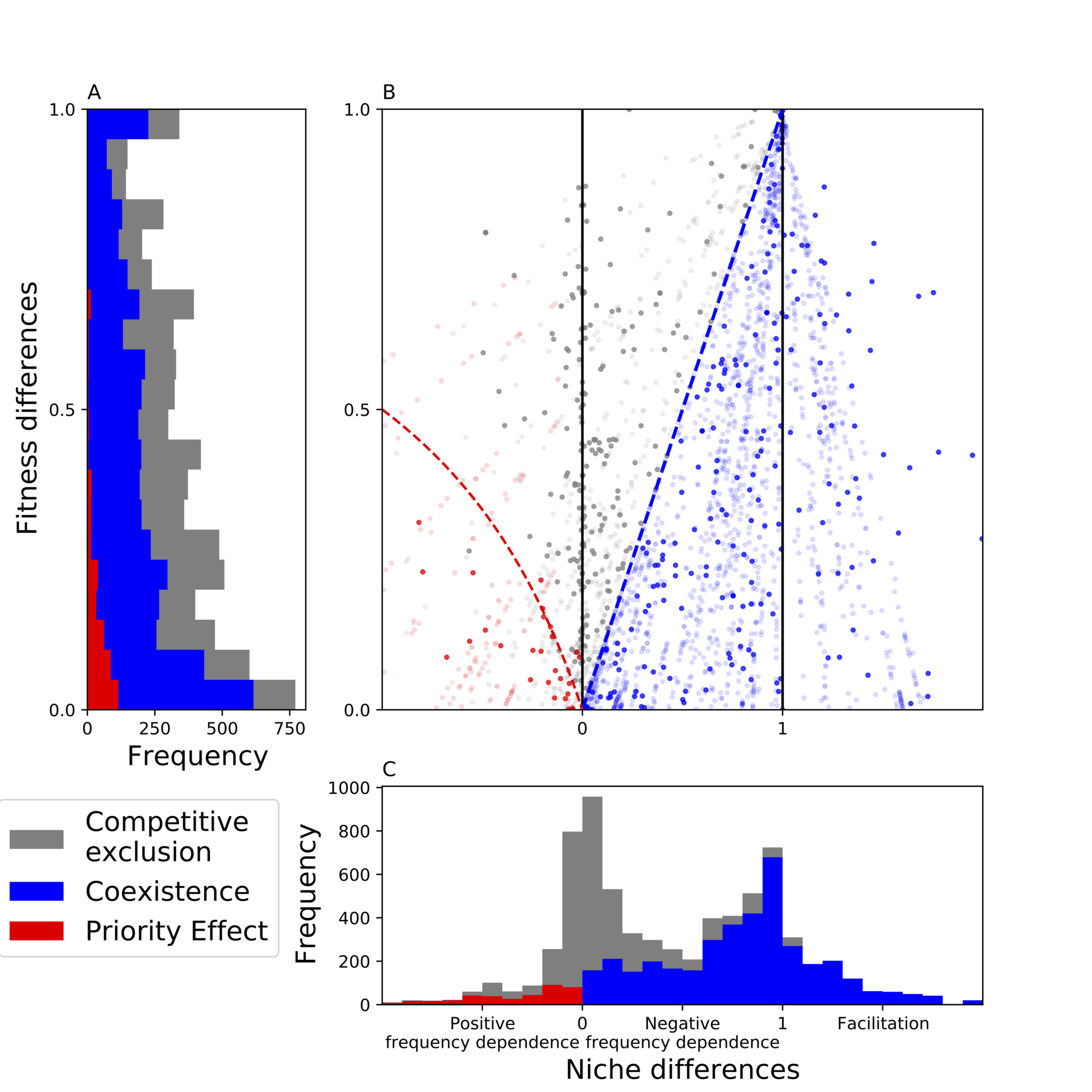
Niche differences, not fitness differences, explain predicted coexistence across ecological groups
Buche, L., Spaak, J.W., Jarillo, J. & De Laender, F.
Journal of Ecology, 1–12, 2022
Based on a meta-analysis of species interactions across taxa, we show the importance of niche differentiation as a mechanism for pairwise coexistence. The coexistence of two species is assessed based on their ability to differentiate along their niche and fitness axes. We show that their difference along the niche axis is more related to coexistence than along their fitness axis.
@article{Buche2022, author = {Lisa Buche and Jurg W. Spaak and Javier Jarillo and Frederik De Laender}, doi = {10.1111/1365-2745.13992}, issn = {0022-0477}, issue = {August}, journal = {Journal of Ecology}, pages = {1-12}, title = {Niche differences, not fitness differences, explain predicted coexistence across ecological groups}, year = {2022}}